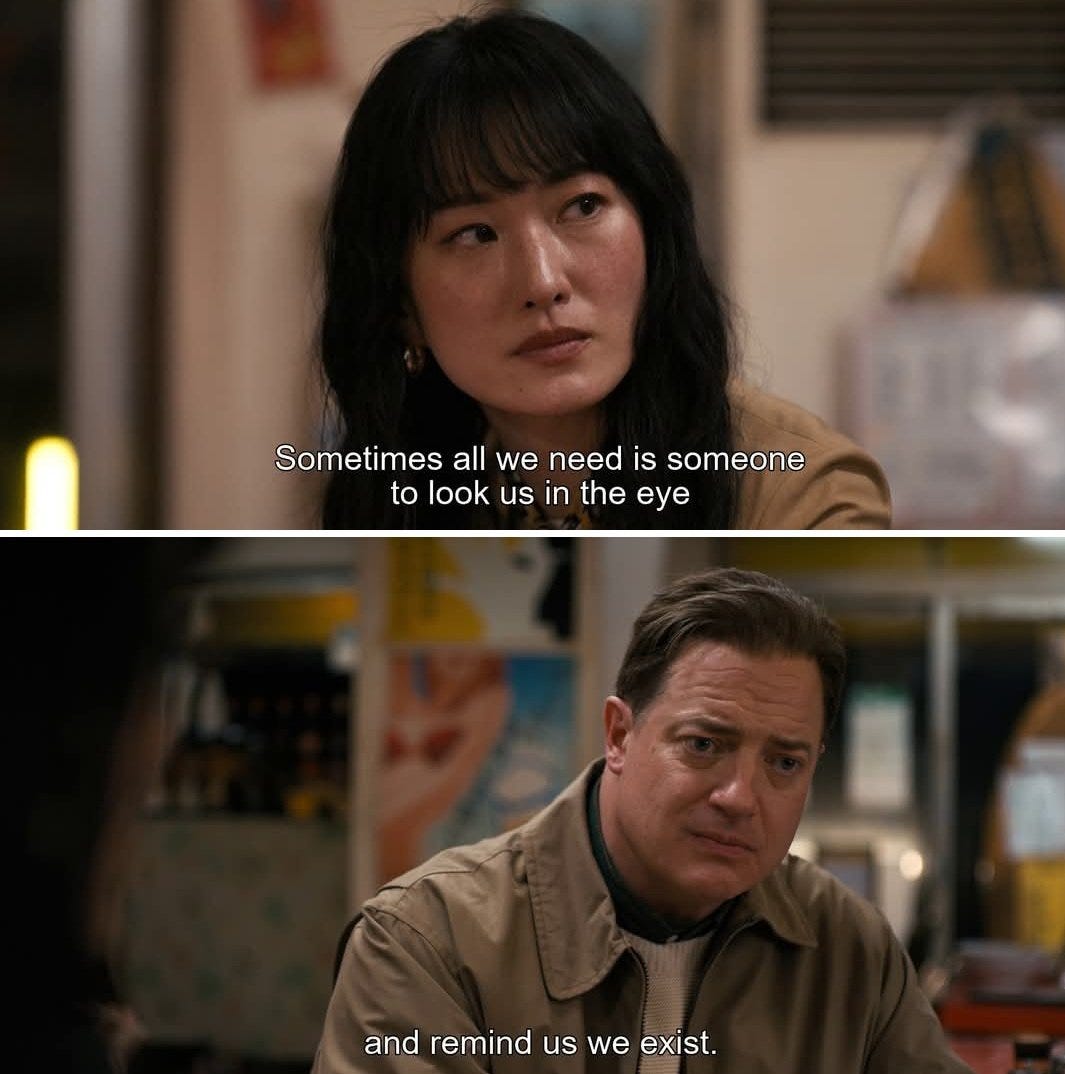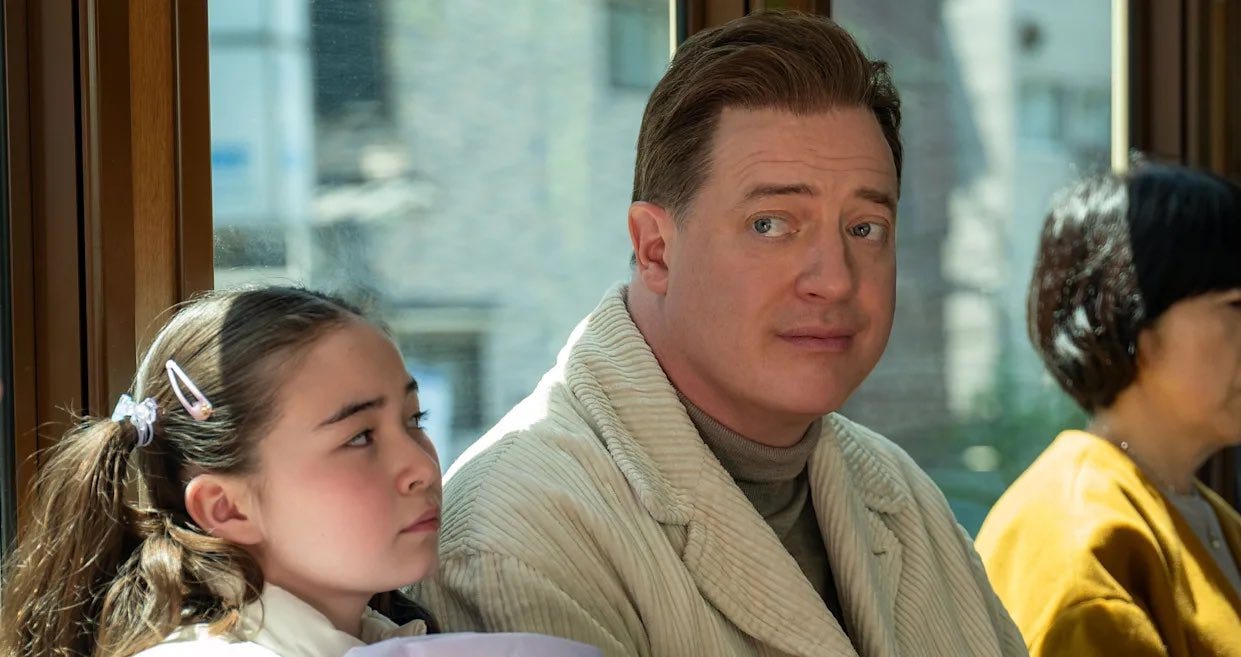
There’s a moment in Rental Family, the 2025 film starring Brendan Fraser, where a man attends a funeral for someone who is not dead. The “deceased” hired him to be there. He needed to see who would grieve him. He needed to know, even at the cost of staging it, that his absence would register somewhere.
Watch that scene, and you’ll feel something uncomfortable stir in you. Not judgment. Recognition.
Brendan Fraser plays Phillip, a washed-up American actor stranded in Tokyo, who stumbles into a job at a “Rental Family” agency. It’s a real industry in Japan, with hundreds of companies that hire professional stand-ins to play whatever role your life is currently missing. A father for a school interview. A friend for a birthday dinner. A son to sit beside a hospital bed.
Phillip becomes, for hire, a father figure to a young girl named Mia. He shows up consistently and tenderly across a series of transactions. And somewhere in the doing of it, something real happens between them. The lie produces a true thing.
We are living through a loneliness epidemic. This is not a metaphor. The United States Surgeon General named it in 2023. People report having fewer close friendships than at any recorded point in modern history, and chronic loneliness now rivals smoking as a health risk. We are more connected than any humans who have ever lived, and among the most isolated.
The easy diagnosis is that technology is to blame, but that misses something older. The rental family industry didn’t start because of smartphones.
It started in the 1980s because modern societies have been dismantling the structures that once held us: the village, the extended family, the neighborhood, and the religious community. We replaced them with efficiency and individual achievement. Then we looked up and found ourselves in rooms full of acquaintances, performing connections without actually having them.
What the film understands, and what most conversations about loneliness miss, is that the problem isn’t the absence of people. It’s the absence of being known.
Phillip attends parties. He has an agent. He is lonely anyway, lonely in the way that comes not from isolation but from invisibility. No one is tracking him. No one holds the accumulated story of his days.
Mia, the girl he is hired to be a father for, gives him a drawing. She texts him about her day. None of it was real, yet Phillip puts the drawing on his bare apartment wall. Because someone noticed him, someone drew their face.
That is what we are all looking for. Not presence, but witness.
Martin Buber wrote about the difference between I-It and I-Thou: the difference between treating another person as an object in your landscape and encountering them as a presence that calls something forth in you. Most of our interactions are I-It. We are processing each other. The rental family industry, strange as it sounds, is in the business of manufacturing I-Thou.
Here is the question the film leaves you with, without resolving it cheaply: if the warmth is real, does the origin matter?
It matters because deception has costs. Mia is hurt when she learns the truth. The ethics of performed connection, when directed at someone who doesn’t know it’s a performance, are genuinely complicated. But the emotion produced by the encounter was not manufactured.
As C.S. Lewis put it, “Friendship is born at the moment when one person says to another, ‘What! You too? I thought I was the only one.’” You cannot fake that recognition in someone else. If Mia felt loved, she felt loved. The scaffolding was false; the building was real.
Most of us will never hire a stand-in family member. But most of us have sought connection in ways we’re not entirely comfortable admitting. We’ve stayed in rooms where we felt invisible because leaving would have meant confirming that invisibility.
We are always, in small ways, arranging for someone to show up. The rental family is just that arrangement made legible.
At the end of the film, Phillip visits a Shinto shrine. At its center is a mirror, the symbol of the soul, of seeing clearly. He looks at it and smiles. He spent the whole film becoming other people. And somewhere in all that becoming, he found himself.
As Rumi wrote, “Out beyond ideas of wrongdoing and rightdoing, there is a field. I’ll meet you there.”
That field is where connection lives. Not in perfect conditions or honest origins, but in the moment someone sees you, and you feel, briefly, less alone.
We’ve built entire cultures around needing each other less, and yet we keep putting drawings on bare walls. That isn’t a weakness. That is the oldest human truth there is.