


A belief feels like reality and stays invisible because nothing challenges it.
It operates like gravity. You don’t notice it. You move according to it. You don’t think, “I believe the ground will hold me.” You walk.
This is the nature of our deepest convictions. They don’t announce themselves as beliefs. They present themselves as they are, and for that reason, we never think to question them.
You can’t examine what you can’t see. You can’t hold up to the light something you mistake for the light itself.
So what makes them visible?
Friction.
In this essay, I want to go through different types of friction that bring to light our deepest convictions.
The first kind is collision. You meet someone who holds a different version of reality, and the disorientation isn’t intellectual. It’s almost physical.
You assume something is how things work, how families operate. What success looks like. What love requires, and then someone walks into your life who moves on entirely different assumptions. They aren’t broken. They aren’t confused.
They just built their life on a different floor. That feeling of “but that’s just… wrong” is often the first signal that you’re looking at a belief, not a fact.
The second is a failure that doesn’t make sense. You do everything right. You follow the script. You hit every mark, and it still doesn’t work. The hidden belief is frequently what’s broken. Not your effort, not your discipline, but the assumption underneath both. That gap between expectation and outcome is where the belief becomes visible, like seeing your reflection in a window only when it gets dark outside.
The third is suffering you can’t explain rationally. Disproportionate emotional reactions are almost always a sign. You’re furious about something small. You’re devastated by something that, on paper, shouldn’t matter that much.
The intensity is the clue. It points downward, beneath the surface event, to something structural. Something load-bearing. When a passing remark ruins your afternoon, the comment isn’t the problem. It struck a wall you didn’t know was there.
And the fourth is language. Sometimes you hear yourself say something and catch it mid-air. “That’s just how the world works.” “People don’t change.” “You have to be realistic.”
Every sentence that frames a belief as a law of nature is worth pausing on. Nature doesn’t need you to defend it. Gravity doesn’t need advocates. The fact that you feel compelled to assert something as a universal truth is often a sign that, somewhere, you sense it might not be.
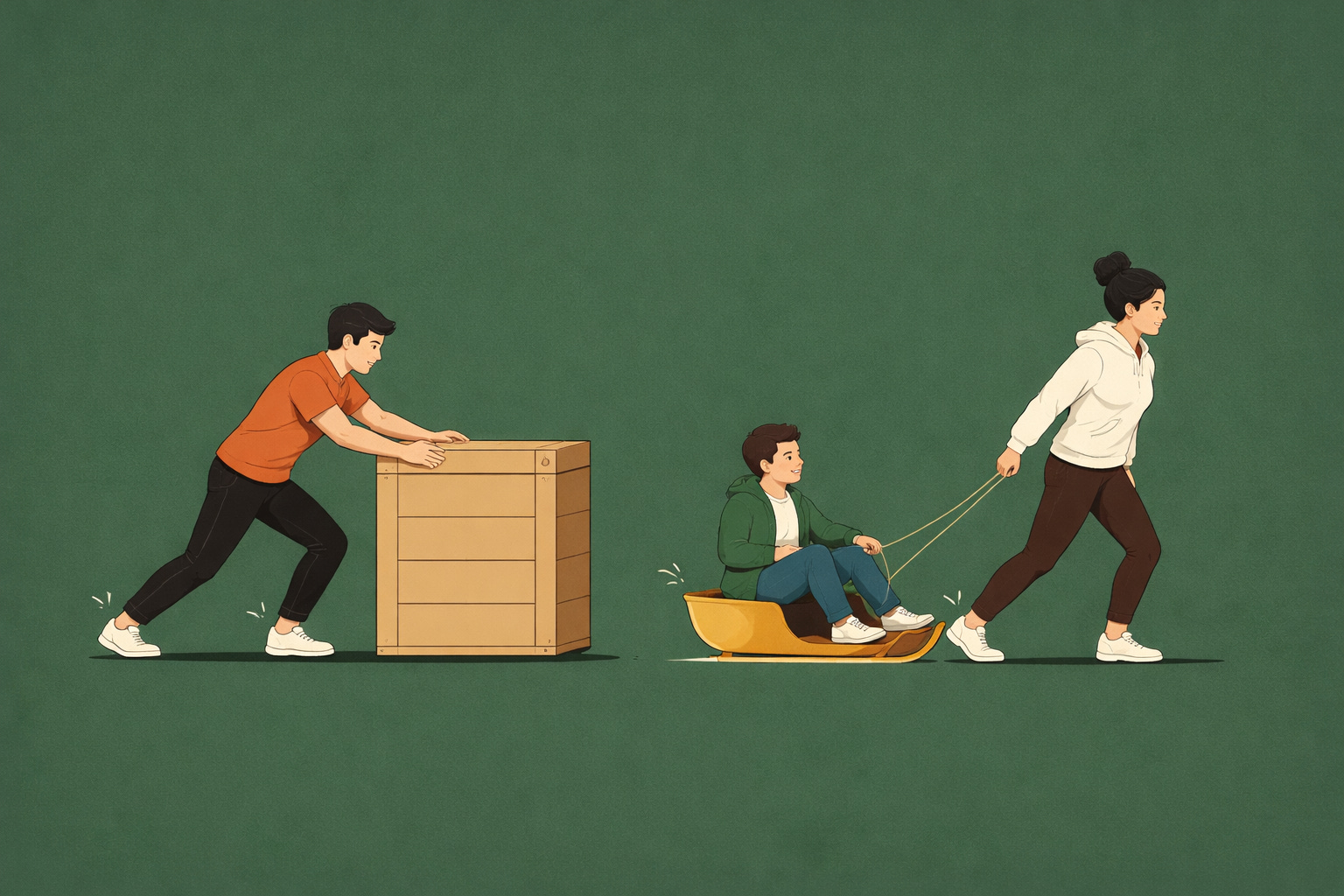
What all of these moments share is disruption. The belief becomes visible not through careful introspection but through contact with something that doesn’t fit: a person, an outcome, a feeling, or a phrase.
The disruption creates a crack, and through that crack, you briefly see the infrastructure of your mind.
The painful irony is that the beliefs most shaping our lives are usually the last ones we examine. The reason is that examining them feels less like questioning an idea and more like threatening the floor beneath our feet.
We don’t resist the examination because we’re stubborn. We resist it because it feels dangerous.
You don’t casually question the thing you’re standing on.
The moments that change us most tend to begin exactly there.