



We often speak about communication as what we say, the words, the tone, and the expressed agreement or disagreement.
But if you have ever sat across from a friend, a partner, or a colleague, feeling a palpable tension that you couldn’t quite place, you know that the most powerful part of communication is often what is not said. It resides in the space between the chairs, in the averted gaze, in the slight stiffness around the mouth.
This silence, heavy and loaded, is shaped by our repressed emotions. These are the feelings, the anger, the jealousy, the hurt, the fear, that we have chosen, consciously or subconsciously, to swallow rather than express. We mistakenly believe that by silencing them within ourselves, we are preventing them from influencing our interactions.
But I want to offer you a different truth: a repressed emotion never truly disappears. It simply stops being an active voice and becomes a powerful, silent gravitational force that warps the space around it. It dictates the terms of the relationship from the shadows.
When we repress an emotion, we are essentially building a small, internal dam. By holding back the water, the area outside the dam will remain dry and safe. We do this for understandable reasons: to maintain peace, to avoid conflict, or to protect ourselves from the vulnerability of exposure.
However, anyone who has ever studied fluid dynamics knows that pressure is proportional to depth. The deeper the emotions we contain, the greater the pressure they exert.
This pressure has to go somewhere, and it often leaks out through non-verbal channels. This is why others can often sense that something is ‘off’ even when you insist, ‘ I’m fine.’
The emotion transforms from a specific feeling into a generalised atmosphere. The repressed resentment of a partner over a minor slight might not be spoken, but it manifests as sarcasm, subtle critique, or perhaps a sudden withdrawal of affection.
The other person picks up on this shift in the atmosphere; they might not know what the problem is, but they feel its weight. The silence, far from being neutral, becomes loaded with implication.
This silent shaping has a devastating long-term effect: it slowly erodes trust and intimacy.
Intimacy requires authenticity. Suppose you are constantly filtering your internal experience, showing only the acceptable facets of yourself while hiding the messy, difficult ones. In that case, you are asking the other person to be in a relationship with a curated version of you. The other person knows, instinctively, that there are closed-off rooms in the house.
This leads to a confusing dynamic. They are responding to the pressure you are exerting, but they are not allowed to respond to the cause. The unsaid truth becomes a hidden landmine, and they spend their energy tiptoeing around the silence, constantly trying to guess what will trigger the tension.
The relationship becomes exhausting because it is built on guesswork rather than clear exchange.
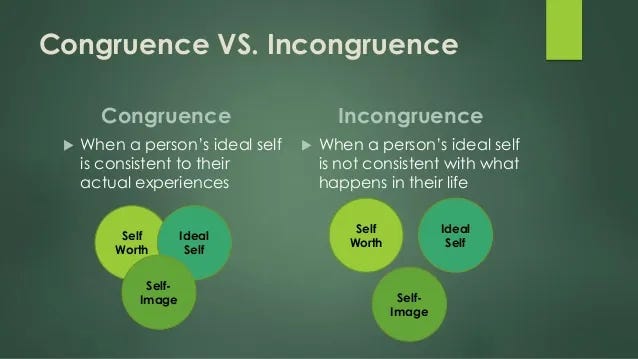
As the great therapist Carl Rogers observed, genuine human connection requires ‘congruence’, the state where our internal experience aligns with our outward expression. When we repress, we deliberately create incongruence, replacing honesty with performance.
The body, too, pays a terrible cost for this internal containment. As we discussed in a previous conversation, the body is where unspoken emotions often settle. The anger that isn’t voiced becomes the persistent tension in the jaw or the chronic pain in the shoulders. The sadness that isn’t wept becomes the heaviness in the chest.
When you are interacting with someone, your physical discomfort, your headache that flares up just as you are about to have a difficult conversation, is not a distraction; it is the physical manifestation of the repressed emotion shaping the interaction. You are subtly communicating your internal state through physiological signals, adding layers of complexity to the silence between you.
The commitment to genuine, deep relationships requires that we manage our emotional containment. This doesn’t mean having zero filters or becoming emotionally explosive. It means acknowledging the difference between delaying an emotion for five minutes to gain composure and repressing it for five years to avoid conflict.
The antidote to the shape-shifting silence is to bring the emotion into the light, giving it a name, and then finding a constructive, gentle way to offer it into the shared space. Only then can the silence between us become a space of peace and quiet understanding, rather than a dense, pressure-filled containment vessel.
To truly connect, we must be brave enough to be legible, even when the words we need to write are tricky to spell out.
Thank you for reading. Your time and attention mean everything. This essay is free, but you can always buy me coffee or visit my shop to support my work. For more thoughts and short notes, please find me on Instagram.