


I come back to this little red book, and this week of all felt like the right time to revisit it.
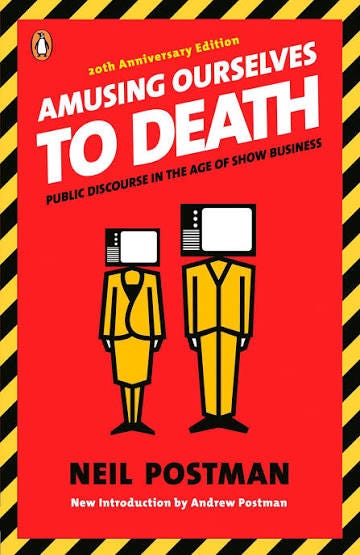
Neil Postman’s 1985 classic Amusing Ourselves to Death argued that the greatest threat to modern society wasn't a totalitarian state censoring information but an endless parade of entertainment rendering the truth irrelevant.
Writing during the rise of cable television, Postman framed his thesis around a contrast between two dystopian visions: George Orwell’s 1984 and Aldous Huxley’s Brave New World.
Postman argued that Orwell feared those who would ban books, deprive us of information, and control us through pain.
Huxley feared that there would be no reason to ban a book because no one would want to read one; we would be controlled by pleasure, drowning in a sea of irrelevance.
Decades later, Postman’s critique of television reads less like a historical critique and more like a precise diagnostic manual for life in the age of smartphones, algorithms, and social media.
In this essay, I will explore how this applies to the modern world, where everything is a click away.
The Infinite “Now… This”
Postman famously dissected the television news transition phrase, “Now… this,” which broadcasters used to bounce instantly from a horrific tragedy to an upbeat commercial or sports score without context or pause. He argued this taught viewers that no piece of news was serious enough to warrant sustained thought.

Today, social media feeds have perfected the “Now… this” architecture into an infinite scroll.
Within a single 30-second window on a phone, a user might watch:
A 10-second clip of a war zone.
A sponsored video for a revolutionary vegetable chopper.
A viral video of a cat falling off a sofa.
A heated political argument in the comments.
Because everything is presented with equal visual weight and immediacy, serious global issues are flattened into mere content alongside light entertainment, rendering deep emotional processing nearly impossible.
Politics as Performance Art
In a print-based culture, political discourse relied on lengthy, complex written debates (like the hours-long Lincoln-Douglas debates of 1858) that demanded patience, logical analysis, and literacy from the audience. Postman observed that television turned politics into show business, where image, charisma, and sound bites replaced coherent policy.
In contemporary life, this shift is complete. Political campaigns are run like influencer marketing strategies (The Guardian termed this the Mamdani effect). Nuanced economic policy or legislative detail struggles to compete with viral dunking, meme culture, and 15-second emotional appeals designed to outrage or entertain.
Politicians are judged less on their administrative record and more on their ability to command screen time and drive engagement (journalist Mehdi Hasan shares how the far right uses this tactic).
The Atrophy of the “Typographic Mind”
Postman believed that reading books cultivates a “typographic mind,” one capable of analytical thinking, delayed gratification, assessing logic, and holding complex ideas in tension. Visual media, by contrast, prioritizes immediate emotion, speed, and sensory gratification.
Modern daily life clearly reflects this cognitive shift. Shortened attention spans, the decline of long-form reading, and the struggle to sit quietly with a single thought are common complaints today.
When information isn’t fast, visual, and entertaining, people increasingly bounce away out of boredom, finding it difficult to engage with complex texts or slow-moving problems.
Gamification and Loving Our Servitude
Perhaps the most prophetic element of Postman’s work is how willingly we participate in this ecosystem.
Orwell’s nightmare required a brutal Big Brother state to enforce compliance. Postman, channeling Huxley, pointed out that people will happily surrender their privacy, attention, and autonomy if you make the process entertaining.
Today, nearly every aspect of life has been gamified and wrapped in an entertainment layer, from investing apps designed like slot machines to language-learning apps with streaks and pop-up rewards.
“What the advertiser needs to know is not what is right about the product but what is wrong about the buyer.” ― Neil Postman
A few months ago, I wanted to buy some cheap, one-time-use party decorations, so I installed the Shein app. What an awful app; it felt like gambling. Why do I need to roll a fortune wheel to buy balloons and pay with my money?
Sadly, we do not need to be forced into screen addiction; we pay hundreds of dollars for the hardware and carry it voluntarily in our pockets everywhere we go.
Postman wasn’t anti-technology or anti-fun; he was anti-unconsciousness. His goal was to make us aware of how the medium shaping our information subtly alters how we think, feel, and organize our lives.
Lately, nothing takes up more time than outrage. It’s either AI slop or anger that draws most of the clicks.
“People will come to adore the technologies that undo their capacities to think.” ― Neil Postman
The Huxleyan Trap of Outrage as Content
In an Orwellian framework, the enemy is clear and concrete: a censor, a specific bad law, or an authoritarian policy. Action is direct, focused, and aimed at a target you can press against.
In a Huxleyan framework, which defines the modern internet, the system pacifies us not by suppressing our anger but by monetizing and feeding it.
Online algorithms thrive on hyper-abstract, high-stakes cultural battles. Debating massive, complex realities like “dismantling the entire patriarchal structure” generates maximum engagement because it triggers deep moral identities and intense emotion.
When an online debate escalates to the point of total systemic breakdown, it becomes a form of high-drama entertainment. The rage itself becomes the product.
The Distraction Mechanism
Your distinction between wanting targeted structural change and demanding the total dissection of an entire overarching system hits precisely on how Postman viewed distraction.
Targeted structural change requires a focused, often tedious effort: altering a specific workplace policy, passing local legislation, organizing community support, or adjusting personal habits. These are areas where your agency is real, measurable, and impactful.
Dissecting the whole structure on a digital forum, while intellectually vast, typically functions as a distraction. Because “the patriarchy” as an abstract, totalizing concept cannot be resolved in a tweet thread or comment section, getting angry about it online creates an endless loop.
This creates a paradox: getting angry about the massive, unfixable abstraction feels like doing important work, but it actually drains the energy needed for smaller, achievable victories.
The platform gives you the emotional catharsis of fighting a giant dragon, which pacifies you just enough that you ignore the practical, incremental changes you could actually influence in your immediate environment.
Of course, I wouldn’t dare to invalidate someone’s experience, but that is why moving from spectator to actor is also vital.
Applying Postman’s lens to your feed helps you spot when an online debate has ceased to be a search for truth or practical reform and has instead become an emotional trap.
When an online space demands that every conversation address the entirety of a massive, systemic issue, it is usually operating as Huxleyan noise.
Recognizing this allows you to step back from the emotional cycle, mute the performance, and redirect your limited time and attention toward concrete, localized structures where your input actually shifts the needle.
When you look at the discussions in your own online circles, do you find that people get resistant when conversations are narrowed down to concrete, actionable steps, as if scaling down the problem makes it feel “less important”?
In Rwanda, there is a powerful cultural anchor called “Imihigo,” which is the practice of setting clear, publicly accountable, and measurable targets.
You can contrast online debate culture with this value.
The internet rewards dramatic rhetoric, viral “dunks,” and endless moral complaints that have no measurable outcome.
Real transformation mirrors Imihigo: choosing a concrete, targeted problem within a school, district, youth co-op, or local startup and setting actionable steps to fix it.
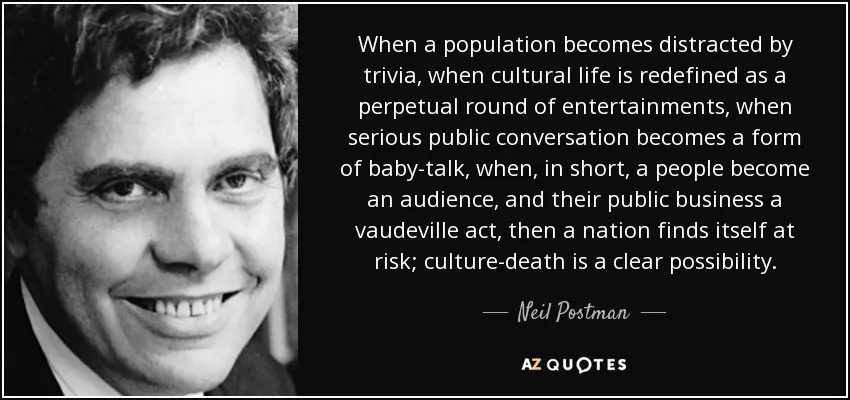
“When a population becomes distracted by trivia, when cultural life is redefined as a perpetual round of entertainments, when serious public conversation becomes a form of baby talk, when, in short, a people become an audience, and their public business a vaudeville act, then a nation finds itself at risk; culture death is a clear possibility.” ― Neil Postman
Postman’s core warning was that entertainment culture tricks citizens into becoming passive spectators who believe they are participating in society simply by consuming or reacting to content.
Warn young people against becoming digital spectators. Retweeting a passionate debate about systemic flaws gives a quick hit of moral satisfaction, but it often pacifies the urge to do actual ground-level work, such as organizing local youth, building a business, or advocating for specific policy changes.
I think it’s important to address the difference between trying to dissect an entire abstract structure online and fixing a real structure in one's immediate environment.
If a young person wants to advance gender equality or economic opportunity, trying to fight the entire global theoretical framework online leads to cynicism and burnout, but directing that same fire toward specific local levers delivers tangible wins.
Delivering visible, real-world progress builds personal and collective dignity far more than shouting into an algorithm ever could.
I would urge any young person to read this book, and if there is one thing to take from this as a young person, it’s this: you can’t tell young people to stop caring about big systemic issues, but you can challenge them to protect their focus, reject passive internet outrage, and choose actionable local building over digital performance.
