


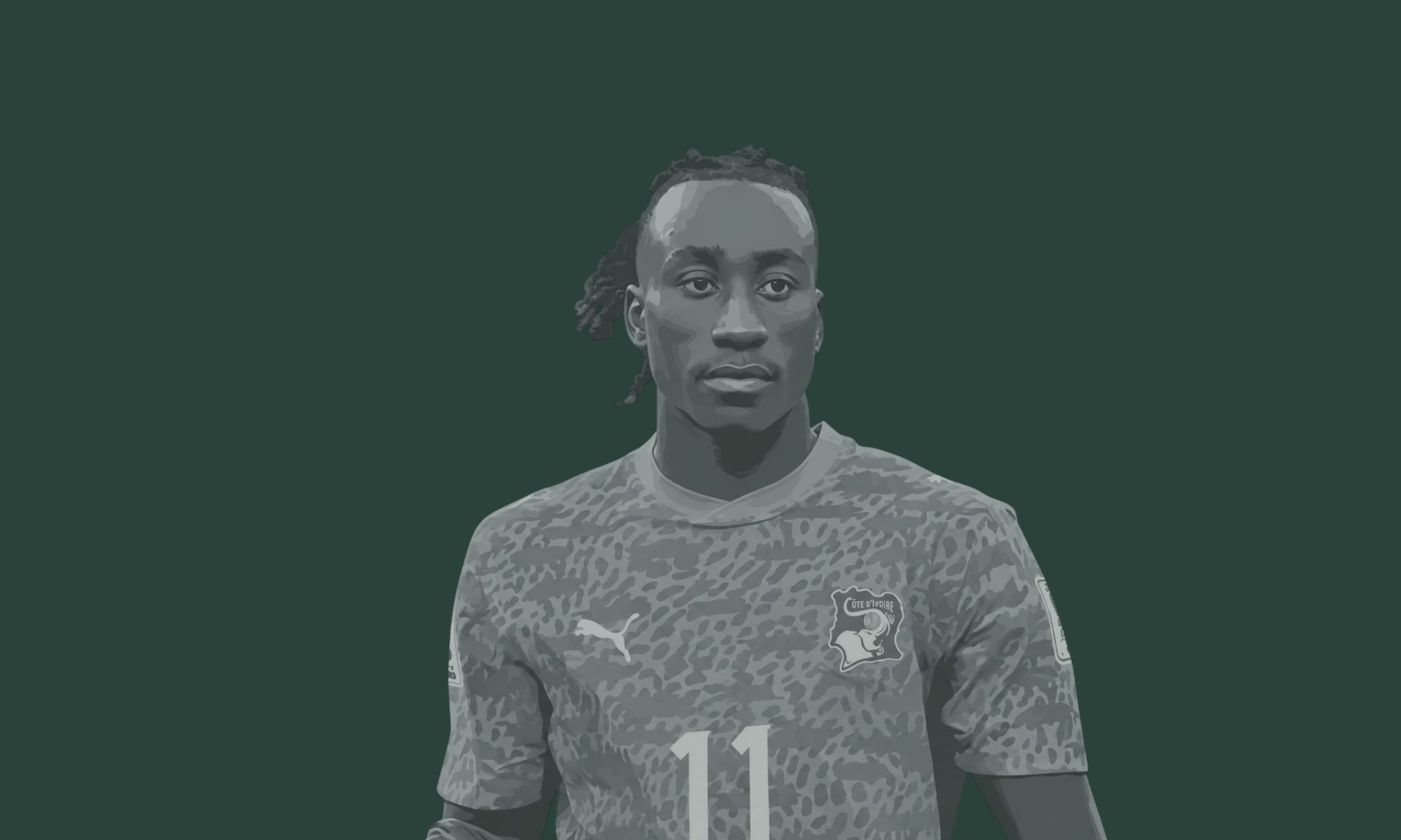
"I wrote this because I can't speak about it."
That was the line Ivory Coast midfielder Yan Diomande used in the letter he published in The Players' Tribune last week. The letter was addressed to his sister, Roxane, who died at fifteen after someone put something in her drink at a party. He never got answers, and he is not sure he wants them.
The letter runs to several pages. It is full of remembered things such as sleeping with football boots, a fake United shirt with Ronaldo 7 drawn in black marker on the back, stealing boiled potatoes near the border because they were hungry.
He wrote all of it down and then, near the end, he explained why: because he could not say it aloud.
I read that sentence several times.
I believe that there is grief that the voice cannot carry. It’s not because the feeling is too large, exactly, but because speech requires you to be present in a way that is sometimes unbearable.
When you speak, someone looks at you, they watch your face arrange itself around what you are saying, and wait for you to finish.
The air between you holds the words briefly before they dissolve. None of that is stable enough for certain things. The throat closes not from weakness but from a kind of wisdom the body has about what it can and cannot offer.
Writing is different.
The page does not look at you. It receives what you give it without flinching, without softening its expression, without making you feel that you need to protect it from what you are about to say.
Diomande addressed his letter directly to Roxane in the second person, as though she might read it as if the act of writing to her were its own form of presence.
He filled it with the word "remember," used again and again, a kind of incantation, a way of naming what is in danger of becoming only his.
That instinct is old.
People have been writing to the dead for as long as there has been writing. It does not require a belief in the supernatural to make sense of it. What it requires is the understanding that grief is partly a problem of address. You have things to say to someone who is no longer reachable by ordinary means. The letter, the diary entry, the poem left at a grave: these are attempts to keep the channel open, to refuse the finality that death insists on.
C.S. Lewis, in the journal he kept after his wife died, described writing as a way of not talking to people who would only say the wrong thing.
Diomande's letter suggests something slightly different: not an avoidance of others, but a movement toward something the voice cannot reach. He writes to Roxane because speech collapses under the weight of her absence, but the page holds what he couldn’t say then and wishes to say now.
What strikes me is that this is not a private document. He published it. He gave it to the world in the same week he left for the World Cup, carrying the country's expectations and his dead sister's name.
The publication of the letter is its own gesture: a way of making good on his promise that everybody would know her name. Writing becomes both the act of mourning and the fulfillment of a vow.
If you have read something from me before, you know that I don’t subscribe to the idea that grief should be processed quietly, dealt with in designated spaces, managed until it no longer inconveniences the timetable.
Diomande plays professional football. He arrives ninety minutes early to everything, and he is also a young man carrying an unanswered question about how his sister died at fifteen, living with a blankness he describes plainly. Since she died, he does not feel anything. He is just blank.
He did not resolve that in the letter, and the letter did not cure him. It did what writing can do: hold a shape around what is shapeless. It gave the grief a recipient, a second person, a name repeated across many paragraphs. Roxane. Roxane. Roxane.
That is not a small thing.
It is one of the oldest uses of language: not to communicate information, but to remain in contact with what we have lost. To write to someone who cannot write back, and to find, in the act of writing, that they are still, in some sense, addressable.
Diomande ends the letter by telling her the World Cup is tomorrow. He tells her he will score and make sure everyone knows her name. He signs it: your brother, Yan.
The page received all of it.