


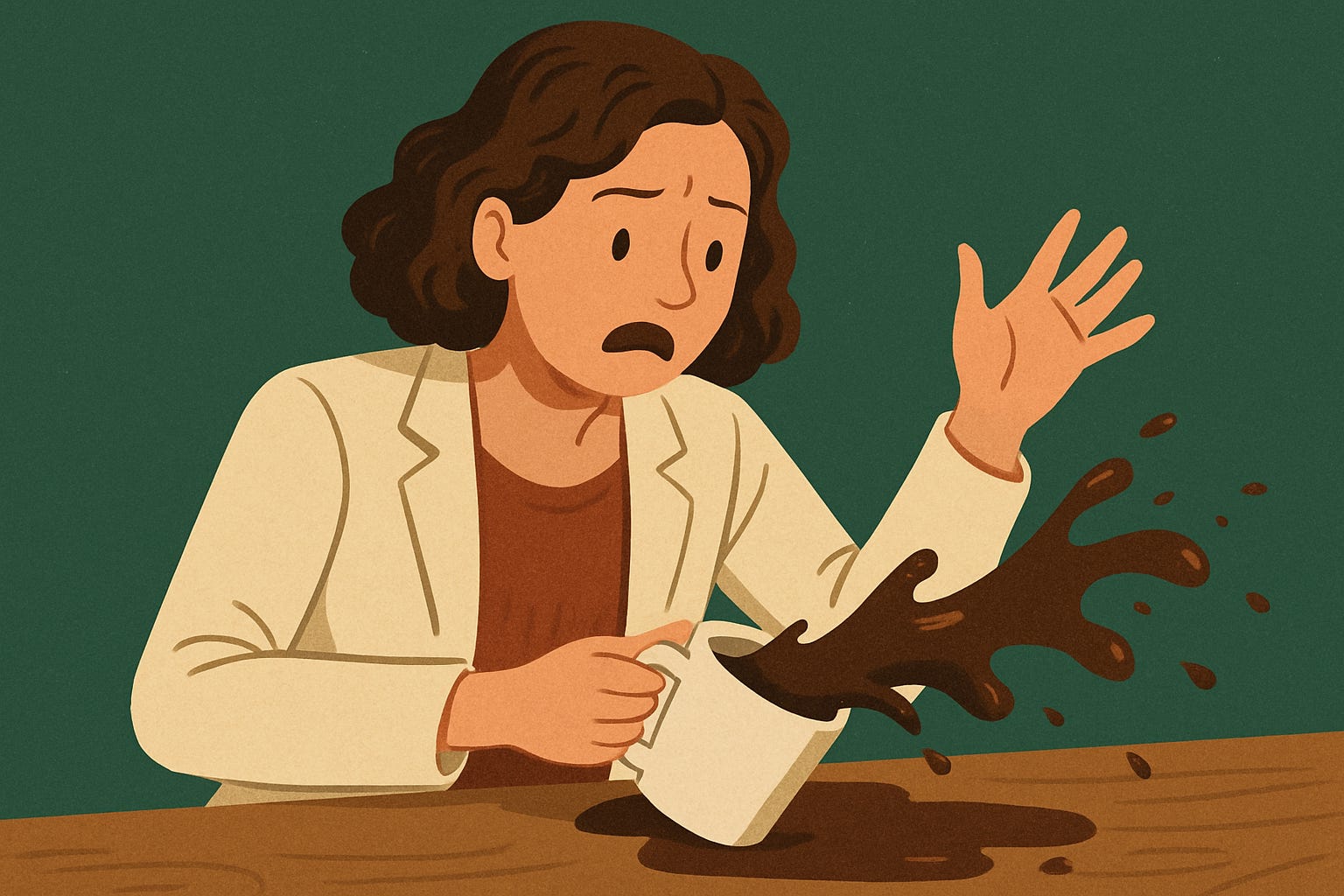
You spilt coffee on yourself this morning.
For the rest of the day, you’re going to interpret this as a sign that you’re clumsy, disorganised, and careless. You’ll carry it with you like evidence.
Someone didn’t laugh at your joke. You’ll spend the evening replaying the moment, wondering what you did wrong. Constructing narratives about your social ineptitude. Building a case against yourself.
You didn’t get the job. Now the story isn’t just that this particular employer chose someone else. Now it’s that you’re not good enough. That you’re fundamentally lacking. That this rejection is data confirming what you secretly suspected about yourself all along.
We do this constantly. We turn neutral events into personal indictments. We see the world as a mirror, continually reflecting judgments about our worth, our competence, our lovability. And we’re almost always harsh critics.
The therapist Albert Ellis called this “personalisation”; the tendency to relate external events to yourself when there’s no factual basis for doing so. It’s one of the most common cognitive distortions. And it’s exhausting.
Because if everything means something about you, then everything is a test. Everything is a performance. Everything is ammunition for your internal critic.
But here’s what’s actually true: most of what happens around you has very little to do with you.
The person who seemed dismissive in the meeting wasn’t thinking about you at all. They were thinking about the fight they had with their partner that morning. They were thinking about their own insecurities, their own problems, their own inner world. They were almost certainly not thinking about you.
The project that fell through wasn’t because you’re incompetent. It was because the market shifted. Because funding dried up. Because someone else got promoted and priorities changed. You were one variable among dozens. And you’ve convinced yourself you were the crucial one.
This is what psychologists call the “fundamental attribution error”, our tendency to overweight personal factors and underweight situational ones when explaining why things happen.
We see someone act rudely and assume they’re rude. We don’t consider them to have just received bad news. We see a failure and think we’re failures. We don’t believe that we encountered obstacles we couldn’t have predicted.
The writer David Foster Wallace talked about this in a commencement speech. He said most of us are utterly self-absorbed. We’re trapped inside our own skulls, seeing the world through the lens of our concerns, our stories, our narratives. And this is torturous.
Because we’re constantly measuring, judging, comparing ourselves against others, others who are far too busy trapped in their own skulls to be thinking about us at all.

The problem with making everything personal is that you’re essentially taking responsibility for things you can’t control. You’re claiming authorship of outcomes that had many authors. You’re volunteering for guilt that isn’t yours to carry.
Someone was rude to you. This says nothing about your worth. It says something about where they are. Their stress level. Their capacity. Their own pain. It has almost nothing to do with you.
You made a mistake. This doesn’t mean you’re a mistake. It means you’re human. Mistakes happen. They’re not character flaws. They’re not permanent marks on your record. They’re just things that happen.
The anthropologist Margaret Mead wrote, “Never doubt that a small group of thoughtful, committed citizens can change the world; indeed, it’s the only thing that ever has.”
But she also understood that most of what happens in the world has very little to do with any person’s actions or worth. We’re all much smaller than we think we are. We’re all far less central to the machinery of the world than our anxious minds suggest.
This should be liberating. It should feel like relief. And sometimes it does. But often it doesn’t, because we’ve been taught the opposite. We’ve been taught that everything is about us. That we’re special.
That our choices matter infinitely. That we’re the centre of our own epic narratives. And we are, in one sense, in the sense that we’re living through our own lives subjectively.
But objectively? You’re not that important. Your failure isn’t that important. Your embarrassment isn’t that important. Your single rejection, mistake, or stumble isn’t the pivot point around which the world turns.
And that’s good news.
Because once you stop making everything personal, you can start making better decisions. You can respond instead of react. When someone disappoints you, you can consider whether this is about them or about you, instead of automatically assuming it’s about you.
When something doesn’t work out, you can analyse what actually happened instead of just absorbing it as evidence of your inadequacy.
The philosopher Epictetus said, “Some things are within your control, and some things are not.”
Most of what happens isn’t within your control. Other people’s reactions. The economy. Luck. Timing. Circumstances. You can’t make everything about you because most things aren’t about you.
What is within your control? Your effort. Your attention. Your willingness to learn from mistakes. Your ability to try again tomorrow. Your character is slowly developed through action, not determined by any single event.
These matter. These are worth focusing on.
But the casual rudeness of a stranger? The particular job you didn’t get? The comment someone made that stung? These are background noise in the vast machinery of existence. And the sooner you stop taking things personally, the sooner you can stop suffering.
The Stoic philosophers spent centuries developing practices for precisely this. They understood that the path to peace isn’t about controlling external events; it’s about influencing how we interpret them.
It’s understanding what’s ours and what isn’t. It’s developing what the Stoics called “prosoche,” or mindfulness, the ability to notice that you’re making things personal and to correct course gently.
You’re going to feel hurt. You’re going to feel rejected. You’re going to feel like you failed. These feelings are real. But they don’t have to be permanent. And they don’t have to mean what you think they mean.

Your worth isn’t determined by any single event. Your competence isn’t established by one success or demolished by one failure. Your social ability isn’t proven or disproven by how one conversation went. These things exist on spectrums, constantly shifting, influenced by countless factors, including things that have absolutely nothing to do with you.
So when you’re about to internalise something as evidence against yourself, pause. Ask yourself: Is this actually about me? Or am I making this about me? Is this something I can actually control? Or am I taking responsibility for something that isn’t mine?
About 80% of what you were about to take personally has very little to do with you at all.
And once you realise that, you’re free. Free from the exhausting work of managing everyone else’s perception of you. Free from the constant self-monitoring. Free from the assumption that you’re constantly being judged. Free to exist.
This doesn’t mean becoming indifferent. It means becoming discerning. It means understanding that other people have their own stuff. The world is more complicated than your role in it. That most of what happens around you is not a referendum on your value.
I may not know you, but you’re spending far more time thinking about how others perceive you than they actually are thinking about you.
You’re carrying a burden they’re not even aware you’re carrying. You’re taking responsibility for narratives they’re not even telling.
So don’t. Let it go. Stop making everything personal.
And discover how much lighter you can be.
Thank you for reading. Your time and attention mean everything. This essay is free, but you can always buy me coffee or visit my shop to support my work. For more thoughts and short notes, please find me on Instagram.