


Big goals are inspiring and paralyzing in equal measure.
You want to write a book, start a business, get in shape, learn a language, and build something meaningful. The vision is clear, but the path isn’t.
The distance between here and there feels impossibly wide, so you either don’t start or you start with enthusiasm that quickly fades when the enormity becomes clear.
The problem isn’t the goal. The problem is treating it as a single massive thing rather than thousands of tiny pieces.
You need a formula for breaking down the overwhelming into the manageable, the impossible into the doable.
Why Big Goals Fail
Most big goals fail not because they’re unachievable but because they’re unstartable (never used this word before).
“Write a book” is too big to be an action.
“Get in shape” doesn’t tell you what to do today.
“Start a business” offers no clear next step.
Your brain needs concrete actions, not abstract aspirations.
Without a clear next physical step, your executive function can’t engage. The goal sits there as this looming should-do that generates guilt but no progress.
Big goals also fail because progress is invisible for too long.
You work on the book for weeks, and you still don’t have a book. You work out for a month, and you still don’t look fit.
The difference between effort and visible results is so wide that motivation dies before you get anywhere meaningful.
The Formula: Outcome → Milestones → Actions → Daily Minimum
Breaking down big goals requires working backward in four clear steps.

Step 1: Define the specific outcome: Not “get in shape” but “run a 10k in under 50 minutes.” Not “start a business” but “make $5,000 monthly revenue from my consulting service.” Not “write a book” but “complete a 60,000-word manuscript on this specific topic.”
Vague goals stay vague. Specific outcomes give you something concrete to reverse-engineer. The more specific, the easier the breakdown becomes.
Step 2: Identify milestones that mark progress: These are the major checkpoints between start and finish. For the book: outline complete, first draft complete, second draft complete, and edited manuscript. For the business: first paying client, five clients, consistent monthly revenue. For fitness: run a 5k without stopping, run a 10k at any pace, and hit the target pace.
Milestones are your proof of progress. They’re substantial enough to feel meaningful but smaller than the ultimate goal. Each milestone achieved proves you’re moving in the right direction.
Step 3: Break milestones into concrete actions: Actions are specific things you can actually do. “Complete outline” becomes brainstorming topics (2 hours), organizing topics into chapters (1 hour), writing a one-paragraph summary of each chapter (3 hours), and revising structure (1 hour). Every milestone should break into 5-15 actions.
If you can’t think of concrete actions, you don’t understand the milestone well enough yet. Research until you can specify exactly what needs doing.
Step 4: Determine your daily minimum. This is the smallest action you can do every day that creates forward momentum. For writing: 250 words daily. For fitness: 15 minutes of running. For business: one outreach email to a potential client.
The daily minimum should be small enough to maintain even on bad days, but substantial enough that doing it consistently gets you to your goal.
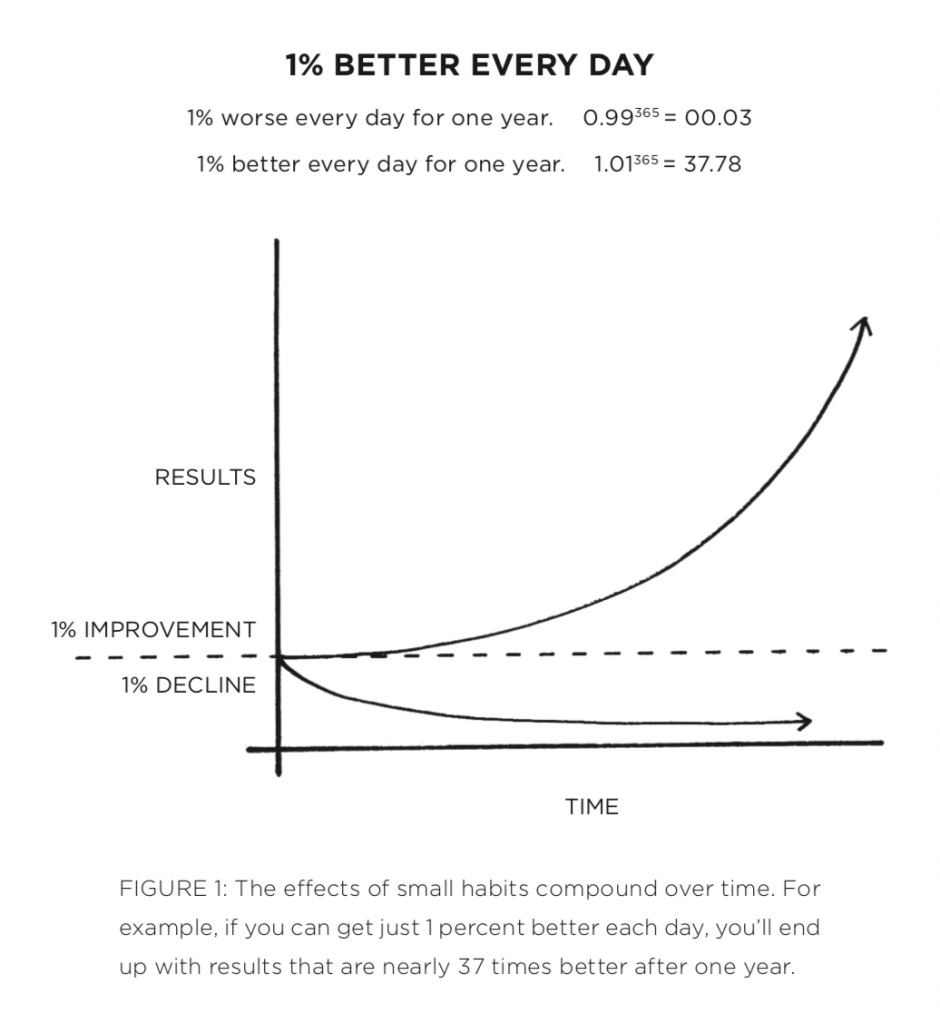
The writer James Clear calls these “atomic habits”: tiny actions that compound over time.
The Power of the Daily Minimum
The daily minimum is where the formula becomes practical.
It transforms “write a book” into “write 250 words today.” That’s doable. That’s concrete. That’s something you can actually do right now.
Over 240 days at 250 words per day, you have a 60,000-word manuscript.
The math is simple, but most people never do the math. They look at 60,000 words as one overwhelming task rather than 240 small tasks.
The daily minimum also solves the motivation problem.
You don’t need massive motivation to write 250 words or run for 15 minutes. You need minimal willpower. This makes consistency possible, and consistency is how big goals actually get achieved.
The author Annie Dillard wrote, “How we spend our days is, of course, how we spend our lives.”
Your daily minimum determines whether the big goal happens. Not your vision, not your passion, not your potential. Your daily minimum.
Working the Formula: Real Example
Let’s apply this to “write a book” as a concrete example.
Outcome: Complete a 60,000-word manuscript on productivity strategies by December 31st. (Today is January 15th; that’s 350 days.)
Milestones:
Research phase complete (20,000 words of notes) - End of February
Detailed outline complete - Mid-March
First draft complete - End of August
Second draft complete - End of October
Final edit complete - End of November
Submit to editor - December 15th
Actions for first milestone (research phase):
List 15 topics to research (1 hour)
Read 3 books on each topic, taking notes (45 hours)
Interview 5 people who’ve achieved what I’m writing about (10 hours)
Organize all notes by theme (5 hours)
Write a summary document of key insights (5 hours)
Daily minimum: Write 300 words (research notes, outline content, or draft) and read for 30 minutes.
On this schedule, the research phase is completed in approximately 70 days, excluding weekends.
Notice how “write a book” became “write 300 words and read 30 minutes today.”
That’s the power of the formula.
Common Mistakes:
Making the daily minimum too ambitious: If you set it too high, you’ll fail to maintain it, which breaks the consistency that makes the system work. Better to do a small amount daily than a large amount sporadically.
Skipping the milestone step: If you go straight from outcome to daily actions, you lose the ability to see progress. Milestones give you wins before the final goal, which sustains motivation.
Not being specific enough in actions: “Work on outline” isn’t an action. “Write a one-sentence summary for each of the 12 chapters” is an action. If you can’t immediately do the thing you’ve written down, it’s not specific enough.
Giving up after missing days: You’ll miss days. That’s fine. The system isn’t about perfection; it’s about consistency over time. Missing three days doesn’t mean failure. It means you start again on day four.
The Compounding Effect
Small daily actions feel insignificant in the moment.
Writing 250 words doesn’t feel like writing a book. Running for 15 minutes doesn’t feel like training for a race. Sending one outreach email doesn’t feel like building a business, but these tiny pieces compound over time.
The writer who does 250 words daily for a year has a book. The runner who does 15 minutes daily for six months can run a 10k. The entrepreneur who sends one email per day for 90 days has spoken with 90 potential clients.
The mathematician and philosopher Alfred North Whitehead observed, “Civilization advances by extending the number of important operations which we can perform without thinking about them.”
Your daily minimum becomes automatic, requiring less willpower as it becomes routine. That’s when big goals become inevitable rather than aspirational.
Big goals fail because they’re too big to act on.
The formula for shattering them into tiny pieces is to define a specific outcome, identify milestones, break them into concrete actions, and determine a daily minimum.
The daily minimum is everything. It transforms impossible goals into manageable tasks. 250 words becomes a book. 15 minutes becomes fitness. One email becomes a business.
Stop staring at the massive goal. Start doing the tiny piece you can do today. Then do it again tomorrow. That’s the formula. That’s how everything meaningful actually gets built.
Thanks for reading!
This newsletter is free, but if you’re feeling generous, you can support my work by sharing it with a friend, buying me a coffee, or checking out more on Instagram.