



You feel angry, so you snap at someone. You feel anxious, so you frantically check your phone. You feel hurt, so you withdraw completely. Most people think this is normal: you feel something and act on it.
Feeling and reacting seem like one continuous process, but they are not.
Feeling is what happens in your body and nervous system. Reacting is what you do in response to the feeling. The difference between them is small in time but massive in consequence. Most of us collapse the two together and call it “being emotional” when really we’re just confusing feeling with reacting.
Learning to separate them, to feel without automatically reacting, is one of the most important skills you can develop for relationships, self-regulation, and living with any measure of wisdom.
So what is feeling?
Feeling is sensation.
It’s the physiological experience of emotion in your body.
Anger is heat, tension, and a tight chest.
Sadness is heaviness, wetness behind the eyes, and slowed movement.
Fear is a rapid heartbeat, shallow breathing, and muscle tension, all ready for flight.
These sensations arise automatically. You don’t choose them.
Something happens, someone criticizes you, you remember a loss, you face uncertainty, and your nervous system responds. Chemicals release. Your body shifts into a particular state. This is a feeling. It’s involuntary, biological, and morally neutral.
Feeling, to put it plainly, is information.
It’s your system telling you something about your internal state or your assessment of a situation. “This feels threatening.” “This feels disappointing.” “This feels joyful.” The feeling itself doesn’t do anything; it just exists as a sensory experience.
The neuroscientist Antonio Damasio found that people with damage to emotional processing centers can’t make good decisions; they get stuck in endless analysis.
Emotions aren’t irrational disruptions to thinking; they’re essential data about what matters to us, but data isn’t action. Feeling the anger is receiving information. What you do with that information is a reaction.
What is reacting?
Reacting is behavior.
It’s what you do in response to the feeling. You feel angry, and you yell, or you suppress it, or you passively-aggressively comply, or you slam doors. You feel anxious and ruminate, compulsively check things, or avoid the situation entirely.
Unlike feelings, reactions are chosen, even when they don’t feel chosen. The choice often happens so quickly and automatically that it seems as if the feeling directly caused the behavior. But there’s always a gap, however tiny, between feeling and reacting. That gap is where your agency lives.
This doesn’t mean all reactions are conscious, deliberate choices. Many are habitual patterns you’ve repeated so many times that they’ve become automatic. You feel rejected; you withdraw; you’ve done this a thousand times. The pattern is so established it feels inevitable. But it’s still a reaction, which means it can be changed.
The psychologist Susan David writes, “Discomfort is the price of admission to a meaningful life.”
Feeling discomfort is inevitable. Reacting to it in ways that make things worse is optional. Most suffering comes not from the feelings themselves but from how we react to them.
Why do we confuse them?
We collapse feelings and reactions into one thing because they happen so close together in time.
When anger comes, you immediately start yelling. There’s no conscious experience of choosing to yell; it just happens. So it seems like the anger made you yell, like the feeling directly caused the reaction.
We also confuse them because we’re not taught to distinguish between them. “I was so angry I couldn’t help yelling” treats the feeling (anger) and the reaction (yelling) as a single inevitable sequence. But anger doesn’t force yelling. You can feel intense anger and decide not to yell. The feeling doesn’t determine the reaction.
Cultural messaging reinforces this confusion. “I couldn’t control myself” implies that feelings override control. “You made me angry” suggests others are responsible for your reactions. “I’m just an emotional person” treats reactions as personality traits rather than choices. All of this obscures the gap between feeling and reacting.
The space between stimulus and response
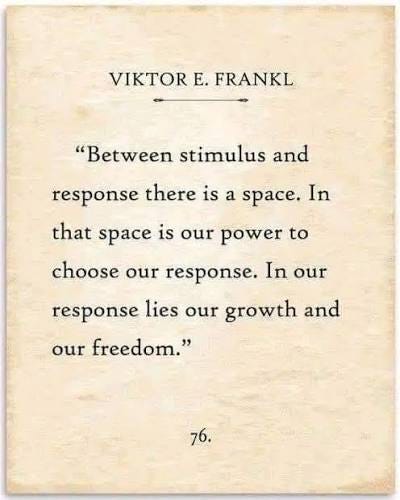
Viktor Frankl’s quote about the space between stimulus and response points to where real freedom lives. You can’t control the feeling; it arrives automatically, but you can influence the reaction if you can find that space, however small, before you act.
This space is where you can pause. Just a moment. Just long enough to notice I’m feeling angry. What do I want to do about that? Not what will I automatically do, but what do I want to do, given my actual goals and values?
The practice of finding this space is simple but not easy. When you feel strong emotion, you pause. You breathe. You notice the sensation in your body without immediately acting on it.
“I feel anger. It’s making my chest tight. My jaw is clenched. I want to yell.”
Just describing what’s happening creates a tiny bit of distance between feeling and reacting.
That distance, that space … is where you can choose a response that actually serves you rather than just discharging the feeling in whatever way feels most immediate.
What Becomes Possible
When you can separate feeling from reacting, everything changes about how you handle emotions.
You can feel without being controlled by the feeling.
Intense anger doesn’t have to lead to yelling. Deep sadness doesn’t have to lead to shutdown. Overwhelming fear doesn’t have to lead to paralysis. You can feel all of it and still decide your behavior based on what actually serves the situation.You can communicate about feelings without acting them out.
Instead of yelling when angry, you can say, “I’m feeling furious right now.” Instead of withdrawing when hurt, you can say, “What you said hurt me.” You’re feeling the emotion and naming it rather than reacting to it. This is far more effective for resolving conflict.You can tolerate uncomfortable feelings.
When feeling and reacting are collapsed together, uncomfortable feelings become intolerable because they seem to demand immediate action. If anger automatically leads to yelling, you can’t be around anything that makes you angry. But if feeling anger is just a sensation, you can be angry without needing to do anything about it immediately.You can learn from feelings. When you’re not busy reacting, you can actually investigate what the feeling is telling you. This anger, what is it about? This anxiety: what’s it trying to protect? This sadness: what needs attention? Feelings become information rather than emergencies.
You can respond instead of reacting.
A reaction is automatic and immediate. A response is considered and chosen. When you separate feeling from reacting, you create space for an actual response, a behavior that takes the feeling into account but isn’t dictated by it.
How to practice the separation
Building the skill of separating feeling from reacting requires deliberate practice, especially with low-stakes emotions first.
Start with physical sensations.
Throughout the day, notice body sensations without doing anything about them. Hunger, tiredness, restlessness, tension. Just notice without immediately acting. This builds the capacity to be with uncomfortable sensations without an automatic reaction.Name emotions when they arise.
“I’m feeling frustrated.” “I’m feeling anxious.” The simple act of naming creates the tiny bit of distance needed to interrupt automatic reaction. You’ve shifted from being the emotion to observing that you’re experiencing it.Practice the pause.
When you notice strong emotion, commit to waiting ten seconds before acting. Just ten seconds of breathing and feeling. Often that’s enough to interrupt automatic patterns and access choice.Notice the urge to react without acting on it.
You feel anger, and you notice the urge to yell, but you don’t yell. You just notice the urge. This teaches you that urges aren’t commands. You can feel the pull toward a behavior without following it.Work with smaller emotions first.
Don’t start by trying to separate feeling from reacting when you’re in a rage or panic. Practice with mild irritation, slight anxiety, and small disappointments. Build the skill with manageable feelings before applying it to overwhelming ones.
When is reacting appropriate?
This isn’t an argument that you should never react or that all reactions are bad. Occasionally, an immediate reaction is appropriate. If there’s genuine danger, you don’t pause to process feelings; you run. If someone’s hurting you, immediate boundary-setting is appropriate. We all should do that.
The goal isn’t to avoid reacting; I doubt that is possible.
It’s to make reacting a choice rather than an automatic process. To be able to react when a reaction serves you and not react when it doesn’t. To have agency over your behavior even when feelings are intense.
Let’s recap this essay: feeling and reacting are different.
A feeling is an involuntary sensation, information from your nervous system. Reacting is a chosen behavior, even when the choice is habitual and automatic. Most people conflate these, treating feelings as if they directly cause reactions.
But there’s a space between them where your power to choose lives. In that space, you can feel without being controlled by the feeling. You can experience intense emotion and still choose behavior that serves you rather than just discharging the feeling.
Learning to find that space, to separate feeling from reacting, gives you freedom. Not freedom from feelings; those will always come, but freedom to choose what you do with them, and that changes everything.