



In “Finite and Infinite Games,” James Carse writes, “A finite game is played for the purpose of winning, an infinite game for the purpose of continuing the play.”
I read that while obsessing over analytics, checking how many people read my work, comparing numbers to other writers, feeling like a failure when my reach was small, and feeling validated when it was large.
I was playing the finite game of audience size and trying to win by accumulating more readers, more attention, and more reach. Every piece of writing was a bid for numbers.
Then I received an email from someone I’d never heard of. They’d found an essay I’d written two years earlier. It was one of my less-read pieces; maybe five hundred people had seen it.
Yet, this person told me it had fundamentally shifted how they understood their relationship with their father. They’d printed it out. Returned to it multiple times. Shared it with their therapist.
One person. Deeply affected. By work that barely registered on my analytics dashboard.
That email mattered more to me than the essay I’d written that reached fifty thousand people, most of whom scrolled past it within thirty seconds.
I realized I’d been measuring the wrong thing. Reach is distance. Impact is depth. I’d been optimizing for distance, while what I actually valued was depth.
The assumption that bigger is better is so pervasive that we don’t question it.
More followers. Wider reach. Going viral is the goal. Building a large platform is a success. We’ve imported marketplace logic into creative work: more customers are better, so a larger audience must be better. Scale is the metric of value.
But watch what happens when you optimize purely for reach: you sand down anything unusual. You simplify anything complex. You avoid anything that might alienate a portion of your potential audience. You create for the largest common denominator.
The work becomes more accessible and less distinctive. You reach more people with something that matters less to each of them.
Depth and distance are inversely related past a certain point.
You can reach a moderate audience with deep work. A few thousand people who really care, really engage, and truly integrate what you’re creating into how they think and live.
Or you can reach a massive audience with shallow work. Millions of people who consume briefly feel entertained or informed for a moment, then move on without being changed.
Both have value. But they’re fundamentally different games. And you usually can’t play both simultaneously with the same work.
The message that goes deep enough to change someone typically contains specificity, nuance, complexity, or perspective that limits its reach.
If it’s for someone, it’s not for everyone.
The message that reaches everyone has to be generic enough not to alienate anyone. It touches many people lightly without transforming any of them.
Small audiences can create asymmetric impact.
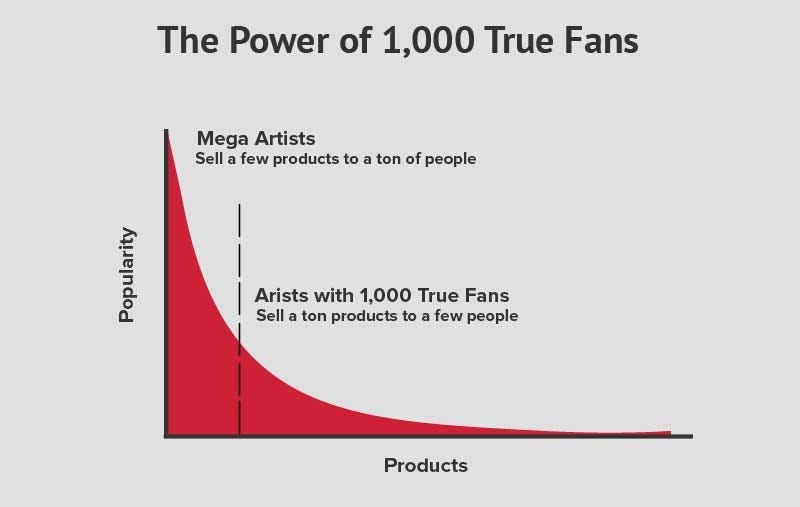
A thousand people who are deeply affected by your work will create more meaningful change than a million people who barely notice it.
Those thousand people might:
Change how they live based on what you created
Share it with the specific people they know would benefit
Build on your ideas in their own work
Form a community around a shared understanding
Remember and return to your work over the years
The million people who scrolled past it once? They moved on immediately. No lasting impact. No changed behavior. No ongoing relationship with the work or its creator.
Kevin Kelly’s essay “1,000 True Fans” articulated this: you don’t need millions of passive consumers. You need a thousand people who care enough about your work to support it directly. That’s sufficient for a sustainable creative career and often more satisfying than the alternative.
Going deep requires saying things that won’t resonate widely.
When I write something complex, nuanced, or specific to a particular experience, I know fewer people will read it. It’s not “relatable” in the broad sense. It’s not easily shareable. It won’t go viral.
But the people who do read it typically say it changed something for them. Because I wasn’t writing for everyone, I was writing for someone. And when that someone finds it, the connection is deep.
When I write something generic and broadly accessible, more people read it. And most of them forget it immediately because it didn’t say anything they couldn’t have read anywhere else.
The trade-off is real.
You can write for depth or for distance, but rarely both simultaneously.
Depth requires excluding as much as including.
This is uncomfortable. It means saying, “This work is for people who…” and accepting that people outside that group won’t connect with it.
Amanda Palmer described her career strategy: make art for the people who already like her art, rather than trying to make art that would appeal to people who don’t yet.
That sounds obvious, but most creators do the opposite. They try to make each new piece appeal to a broader audience than the last. They dilute what makes them distinctive in pursuit of a wider reach.
Palmer did the reverse: she went deeper with the people who already resonated with her work. Her audience was smaller than many mainstream artists’, but the relationship was deeper.
Deep enough that when she crowdfunded an album, those thousand true fans contributed enough to make it one of the most successful music crowdfunding campaigns ever.
The depth-first strategy is counterintuitive in the attention economy.
Every platform metric rewards reach. Followers. Impressions. Engagement rate (which is actually about volume of engagement, not depth). Shares = Virality.
None of these measures depth. None of these tells you whether anyone was changed by what you created. They just tell you how many people briefly encountered it.
So the incentive structure pushes toward optimizing for distance. And most creators follow those incentives without realizing they’re abandoning depth in the process.
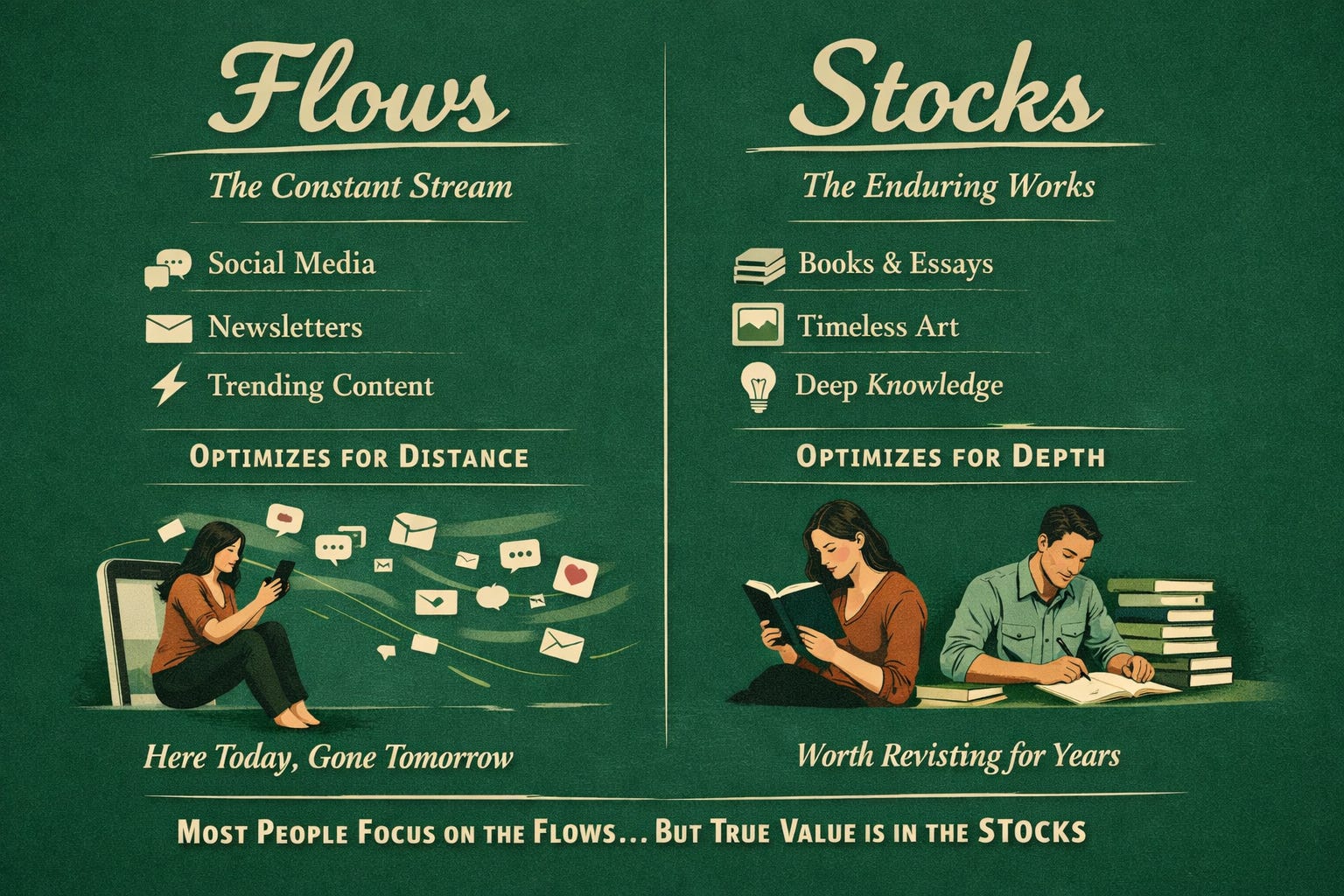
Robin Sloan describes this as the difference between stocks and flows.
Flows are the constant stream of social media posts, newsletters, and content that reach people and pass them by.
Stocks are the enduring works, essays, books, and art that people return to over the years.
Flows optimize for distance. Stocks optimize for depth. Most people focus entirely on flows because that’s what the metrics measure.
Depth allows for complexity that distance forbids.
When you’re writing for a small, specific audience, you can assume shared context. You can build on previous ideas. You can use specialized language. You can be subtle, nuanced, and paradoxical.
When you’re writing for mass reach, you have to explain everything. Define every term. Avoid anything too complex or unusual. Avoid generalizations that everyone can access immediately.
The first approach allows depth. The second requires simplification.
Work that goes deep with a small audience sometimes reaches a wider audience later, but only after the depth has been established.
Books that become classics often weren’t bestsellers immediately. They found their true fans first, who kept recommending them until their reach eventually expanded.
Musicians who build dedicated followings through deep connection with small audiences sometimes break through to the mainstream later, but only because they didn’t compromise the depth that made them worth following in the first place.
The path is depth-first, then distance as a possible consequence.
Not distance first, hoping it will create depth.
The question is what you’re optimizing for and why.
There’s nothing wrong with wanting reach. If your goal is to spread information to as many people as possible, optimizing for distance makes sense.
If your goal is to create meaningful impact, to change how people think or live, or to build lasting work rather than momentary attention, then optimizing for depth makes more sense.
Most creators haven’t consciously chosen. They’ve just defaulted to reach because that’s what’s measured and rewarded. Then they feel frustrated that their large audience doesn’t seem to care deeply about their work.
You are built for distance. You got distance.
Why are you confused that you didn’t get depth?
Depth requires patience that platforms don’t reward.
Deep work takes time to create and time to be understood. A thoughtful essay might take days to write and require focused attention to read. That’s incompatible with algorithmic preference for quick production and quick consumption.
The work that endures is almost always work that went deep rather than wide. The books that matter decades later. The essays that people still reference years after publication. The art that changes how people see.
None of that shows up in this week’s analytics. All of it shows up in whether anyone cares about your work five years from now.
The experienced creator has learned that small, deeply engaged audiences are more valuable than large, unengaged ones. They’ve stopped optimizing for metrics that measure distance and have started paying attention to depth signals.
When you’re creating something, ask yourself: am I trying to reach more people, or to matter more to the people I reach?
Are you simplifying to expand reach or accepting limited reach to maintain complexity? Are you measuring success by numbers or by whether anyone was actually changed?
Depth over distance doesn’t mean reach is bad. It means recognizing that reach and impact aren’t the same thing and deciding which one you’re actually trying to create.
Sometimes, one person deeply affected matters more than ten thousand people briefly entertained.
Everything else is just confusing audience size with meaningful work.