


The best stories are about extremes. Someone quits their job with no backup plan and builds a billion-dollar company. An athlete trains through injuries and impossible odds to win the championship. A writer locks themselves in a cabin and emerges six weeks later with a finished novel.
We love these stories because they’re dramatic. They confirm our belief that greatness requires suffering, that achievement demands everything from us, that success is about those pivotal moments where we push beyond our limits.
But if you look closely at almost any real achievement, you’ll find something far less cinematic underneath: someone showing up, doing the work, and repeating that process for far longer than seems exciting or romantic.
The Allure of Intensity
Intensity feels productive. When you’re working at maximum capacity, pulling all-nighters, sacrificing everything else for your goal, you feel like you’re making real progress. The exhaustion itself becomes evidence of commitment.
There’s also something satisfying about intensity. It fits our cultural narrative about success. It’s what we see in movies, read in books, and hear in interviews with successful people: the compressed timelines, the dramatic sacrifices, the heroic efforts.
Intensity makes you feel different from other people. You’re not only working on a goal, but you’re also someone who wants it more, who’s willing to do what others won’t. There’s an identity wrapped up in being the person who works harder than everyone else.
And intensity absolutely does work, for a while. You can accomplish a great deal in a short burst of focused effort. Marathon study sessions before exams. Deadline-driven work sprints. A month of extreme dedication to fitness.
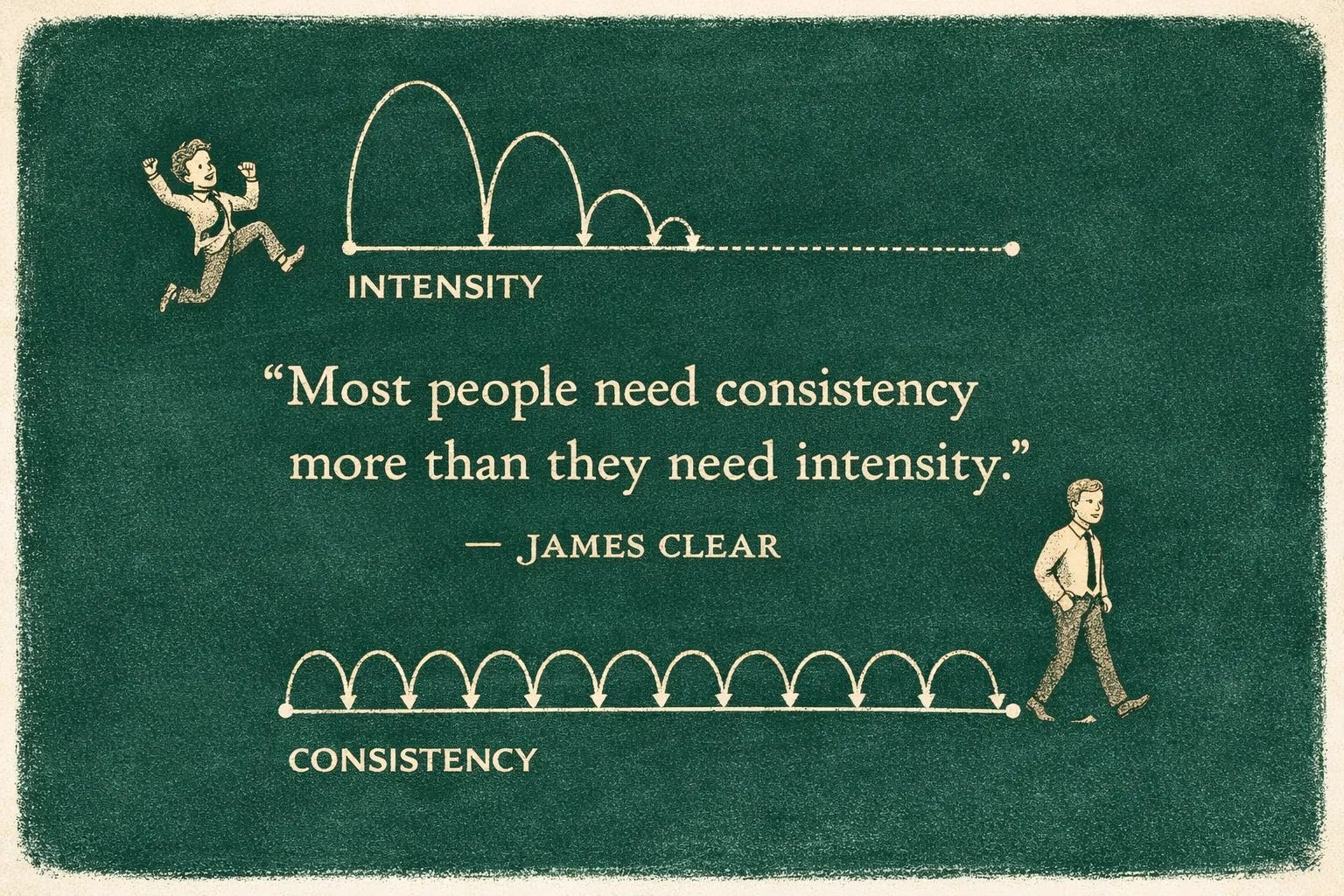
The problem isn’t that intensity doesn’t work. The problem is that it doesn’t last.
The Reality of Consistency
Consistency is boring. It doesn’t make for good conversation at parties. Nobody’s writing a movie about someone who went to the gym three times a week for three years, or wrote 500 words every morning for a decade, or practiced their craft for an hour each evening after work.
Yet this is how almost everything meaningful actually gets built.
Learning a language isn’t about one intensive month of complete immersion (though that helps). It’s about engaging with the language regularly for years until it becomes second nature.
Building a business isn’t about one brilliant weekend of hustle. It’s about making sales calls, improving your product, and solving problems every single week until you have something sustainable.
Getting in shape isn’t about a brutal 90-day transformation(don’t let Hollywood fool you). It’s about making exercise and nutrition part of your regular life.
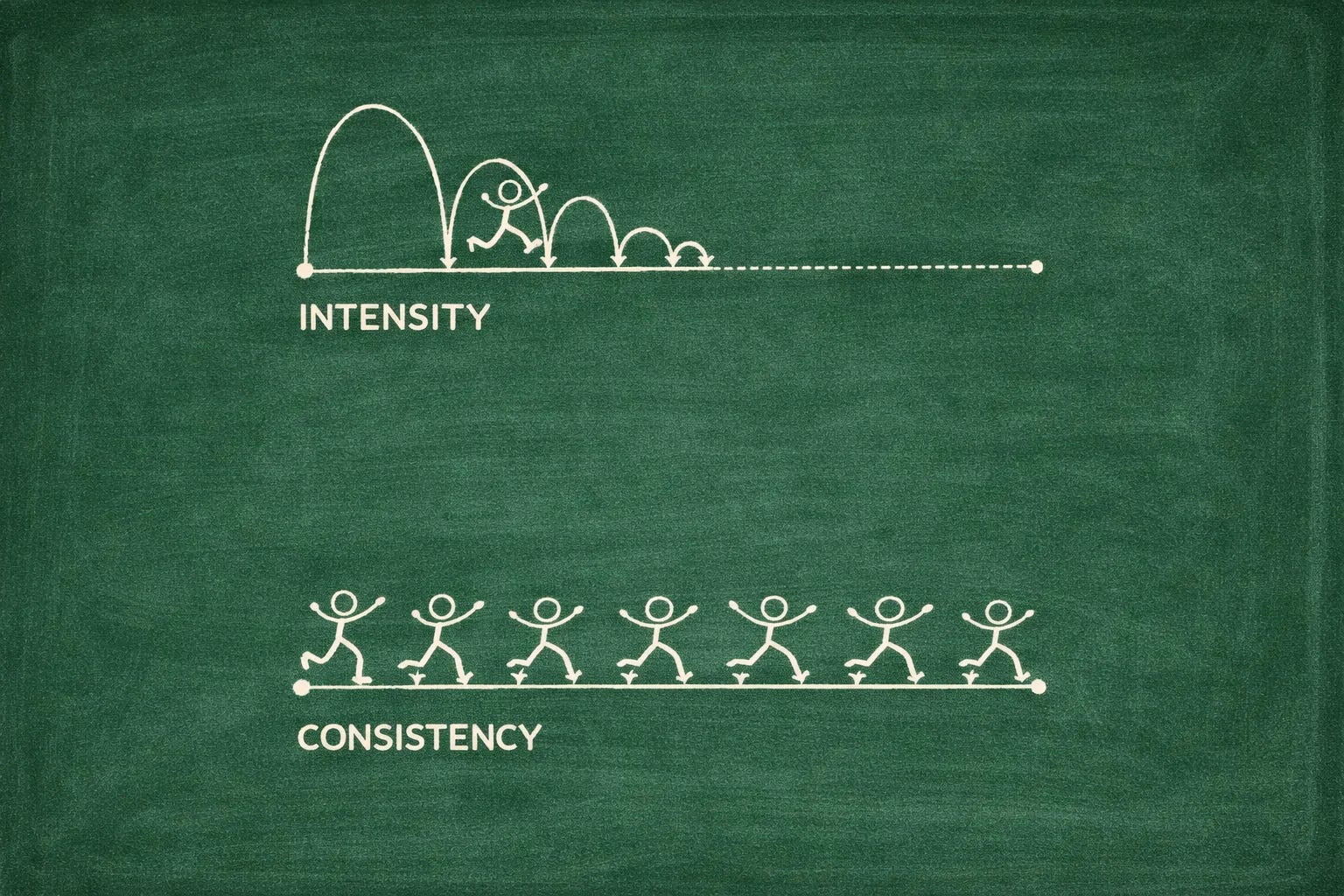
The math of consistency is ruthless. Someone who works intensely for a month and then burns out will be lapped by someone who works moderately for a year.
The compound effect of daily effort overwhelms almost any burst of intense activity.
Think about it this way: would you rather write for eight hours once, or for one hour eight times? The eight-hour session feels more impressive, but the one-hour sessions produce better work. You’re fresher each time, you have time to think between sessions, and you’re building a habit rather than exhausting yourself.
Why Consistency Beats Intensity
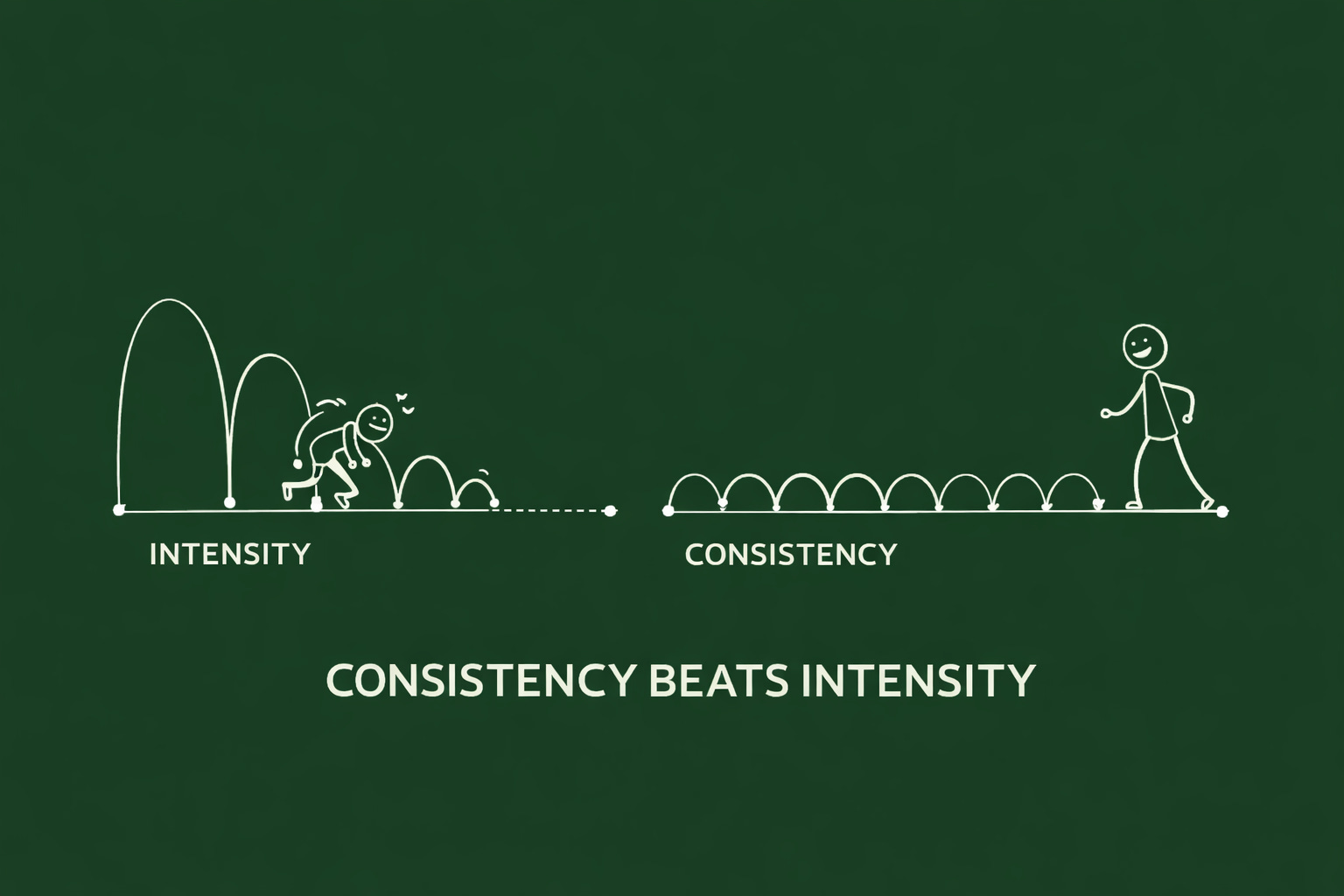
The first reason consistency wins is that it’s sustainable. You can maintain moderate effort indefinitely. You can go to the gym three times a week for the rest of your life. You can write every morning for decades. You can practice an instrument regularly without burnout.
Intensity, by definition, cannot be sustained. If you could maintain it indefinitely, it wouldn’t be intensity anymore. It would just be your normal level of effort.
The second reason is that consistency builds skill more effectively. Skill acquisition requires repetition with time for consolidation. When you practice something intensely for a short period, you’re mainly working from short-term memory and sheer determination.
When you practice regularly over time, you’re building actual neural pathways and genuine understanding.
This is why cramming for exams produces worse long-term retention than spaced study. Why weekend warriors get injured more than regular exercisers. Why writing a novel in a month produces rougher results than writing a chapter each month for a year.
The third reason is that consistency compounds. Each day’s effort builds on the day before. Your baseline keeps rising. What felt difficult three months ago becomes easy. What seemed impossible last year becomes your new normal.
This compounding effect is invisible in the short term but overwhelming in the long term.
The Hidden Cost of Intensity
Beyond sustainability, intensity has some less obvious costs.
It warps your relationship with the work itself. When everything is an emergency, when you’re always pushing to your absolute limit, the work stops being something you enjoy and becomes something you endure. You start associating your goal with exhaustion and sacrifice rather than growth and satisfaction.
This matters because at some point, probably years before you achieve what you’re working toward, you’re going to ask yourself if it’s worth it. If your primary association with the work is suffering, the answer will be no.
Intensity also makes you fragile. When your only mode is maximum effort, you have no buffer for when life gets difficult. And life always gets difficult. Something unexpected happens, your circumstances change, you get sick, or you have a bad week. If your entire system depends on operating at peak capacity, these disruptions derail everything.
Consistent effort at a moderate level is resilient. You can miss a day and resume the next. You can have a difficult month and still maintain the core habit. You’re building something that can weather normal human variability.
Finally, intensity often masks strategic problems. When you’re working incredibly hard, it’s easy to mistake motion for progress. You feel productive, you’re exhausted, surely you must be getting somewhere. But intensity can keep you busy enough that you never pause to ask whether you’re working on the right things.
Building a Practice of Consistency
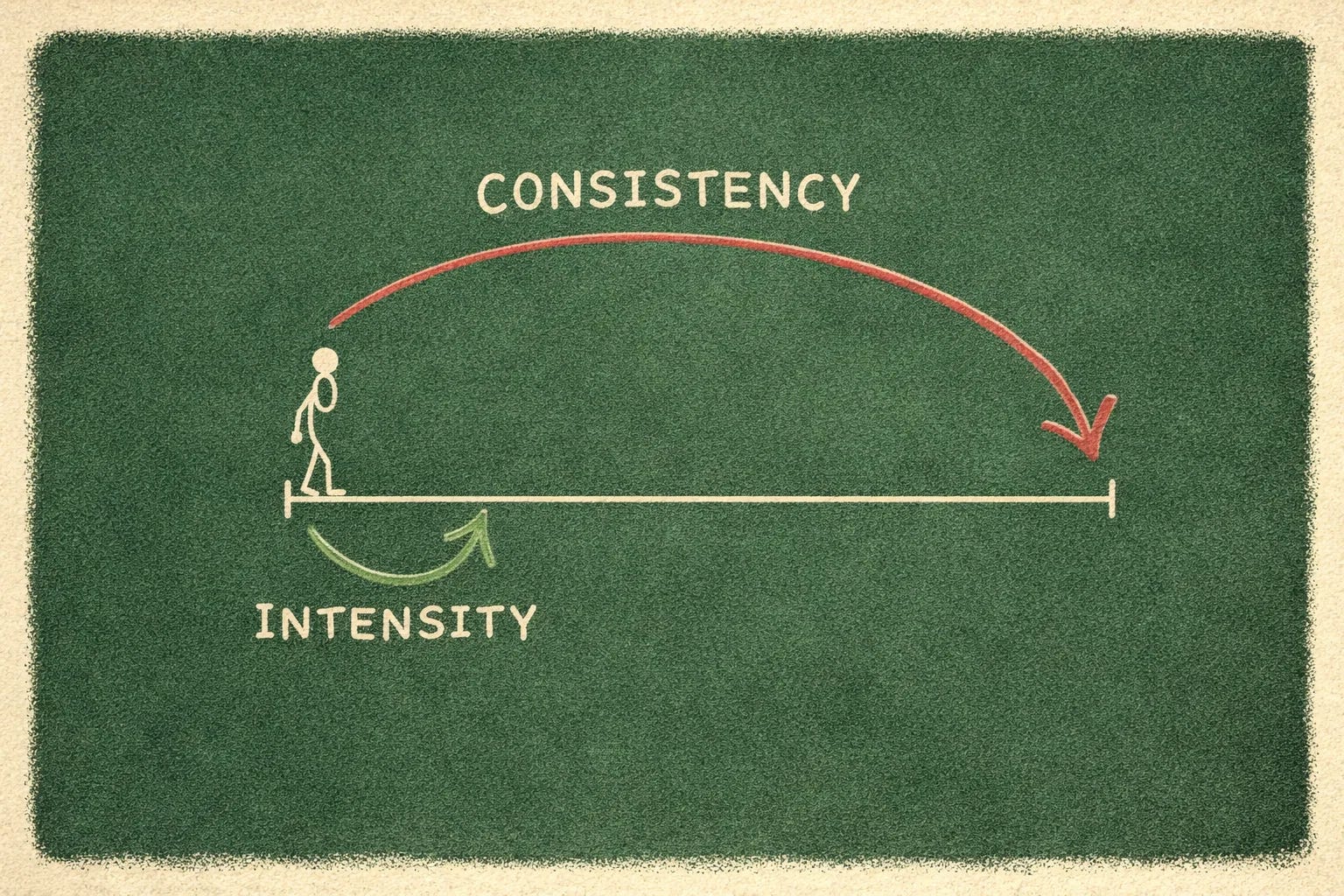
The challenge with consistency is that it requires a different kind of discipline than intensity does.
Intensity is about motivation and willpower. Consistency is about systems and habits.
Start smaller than you think you should. The goal isn’t to do as much as possible. The goal is to do something sustainable. If you can only commit to 15 minutes a day, do so. Consistent beats ambitious, but abandoned every time.
Make it easy to start. The most significant barrier to consistency is friction. Every obstacle between you and the work is an opportunity to quit. Lay out your workout clothes the night before. Keep your writing document open on your computer. Remove as many decisions and barriers as possible.
Track your consistency, not your results. Results take time and depend on factors outside your control. Consistency is entirely within your control and gives you immediate feedback. Did you show up today? Yes or no. Simple, clear, actionable.
Build identity around the process, not the outcome. Don’t think of yourself as someone trying to get fit. Think of yourself as someone who exercises. Don’t think of yourself as an aspiring writer. Think of yourself as someone who writes. Identity drives behavior more effectively than goals do.
When Intensity Has Its Place
Intensity isn’t useless. It has specific applications where it works well.
Short-term sprints to build momentum when starting something new can be valuable. A week of intensive focus can get you over the initial hump and establish the basics. Then you transition to consistency.
Deadline-driven work sometimes requires intensity. When you have a genuine, fixed deadline and you’re behind, intensity is necessary. But this should be the exception, not your default mode of operation.
Breaking through plateaus occasionally requires a period of intense effort. When you’ve been consistent for a long time and you’re stuck, a concentrated push can help you reach the next level. But again, this works because it’s punctuating a foundation of consistency, not replacing it.
The key is knowing the difference between intensity as a tool and intensity as a lifestyle. One is strategic. The other is unsustainable.
Real life isn’t like in movies.

We romanticize intensity because it makes for better stories. The all-nighter, the dramatic sacrifice, the heroic push through difficulty, these are the moments we remember and retell.
But if you actually want results, if you're going to build something meaningful and lasting, you need consistency. You need to show up regularly, do the work, and trust the compound effect of sustained effort.
It won’t make for a dramatic story. Nobody’s going to make a movie about your daily practice. But in ten years, you’ll have achieved something real while the intensity-driven people are still searching for their next burst of motivation.
Intensity makes for a good story. Consistency makes for a good life.